

We help South Florida businesses with 15+ employees get reliable IT support.
Let's onboard you for free, lock in your rate, and handle the switch.




Choosing an IT consulting firm based mainly on their cybersecurity checklist can actually weaken your overall technology strategy. A narrow focus on security controls can create blind spots in your cloud and software systems.
When a security checklist fails to line up with how a business actually runs, the cost shows up later: integrations that break, workflows that stall, and fixes that arrive as surprise invoices.
Choosing an IT consulting company often starts with that very checklist, especially for cybersecurity, and the logic feels sound since security sits near the top of almost every business's concerns.
Yet that narrow focus can hide a different problem. The systems those checkbox protections are meant to defend may not be nearly as solid as the checklist suggests.
IT consulting, in practice, reaches far past security. It shapes how a business uses technology day to day, how teams collaborate, and how data moves between systems, so a vendor's security checklist alone shows only a slice of that larger picture.

A cybersecurity checklist earns its place as a tool: firewalls, password policies, data backups all belong on it. Even so, a checklist is only as strong as the strategy standing behind it.
Picking an IT consulting firm mainly on the strength of its security checklist means skipping over harder, more useful questions. Does the firm's approach actually fit the business's real operations? Can its solutions stretch as the business grows, or do they lock things in place?
A checklist can confirm that certain controls exist, but it rarely shows how those controls interact with the software, cloud services, and daily operations around them. That silence is exactly where exposure hides, often in ways a business won't notice until something breaks.
Cloud computing and software tools now sit at the center of most businesses, connecting teams, holding data, and keeping operations moving. Because so much depends on them, the way they get secured matters as much as whether they get secured.
Pick an IT consulting partner for its security checklist alone, and the cloud and software strategy built on top of that choice can turn fragile. Security controls, after all, say nothing about whether systems are well-integrated or easy for people to actually use.
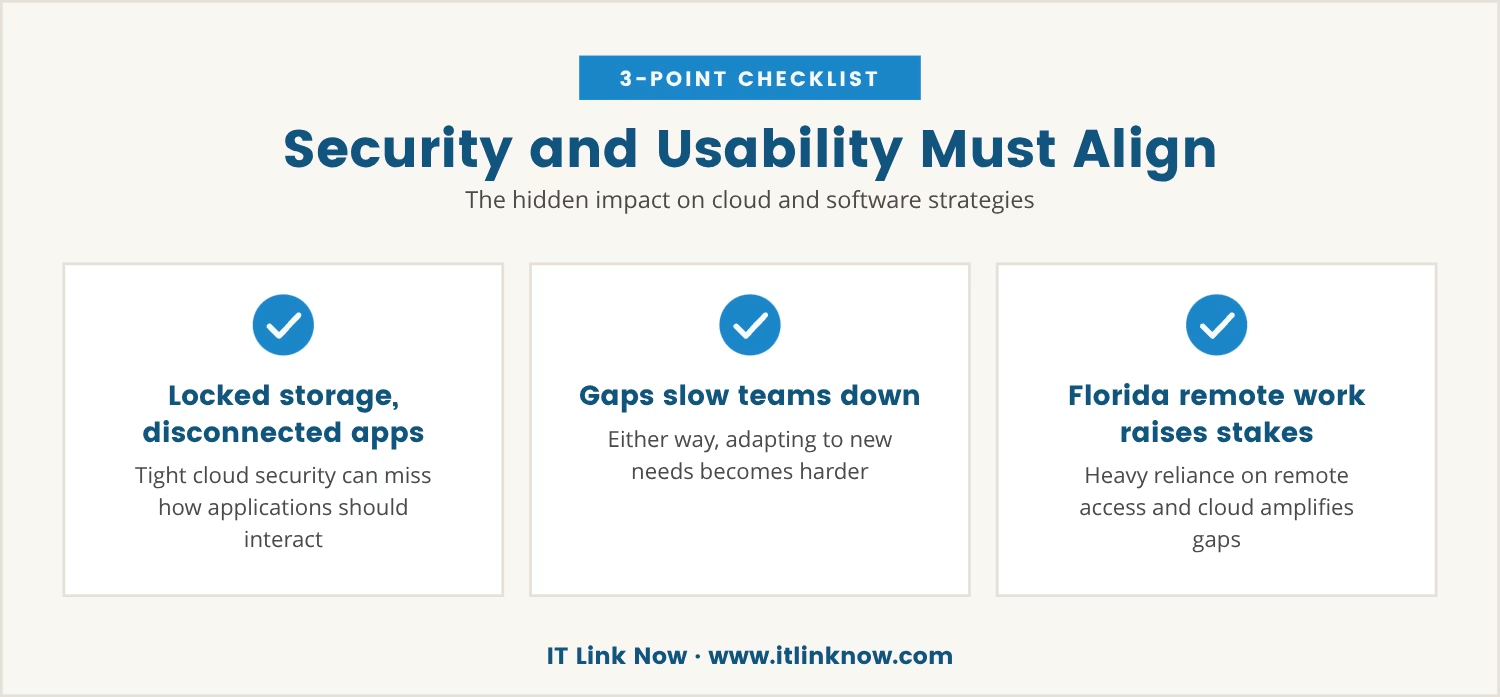
A vendor might clear every security box while recommending software that fights the existing workflow. Or it might lock down cloud storage tightly while missing how the applications inside it are supposed to talk to each other. Either way, the team slows down, and adapting to new needs gets harder than it should be.
In Florida, where so many businesses lean on remote access and cloud services, gaps like these turn into real operational problems fast. The IT consulting firms worth hiring treat security and usability as a single problem, not two separate ones.
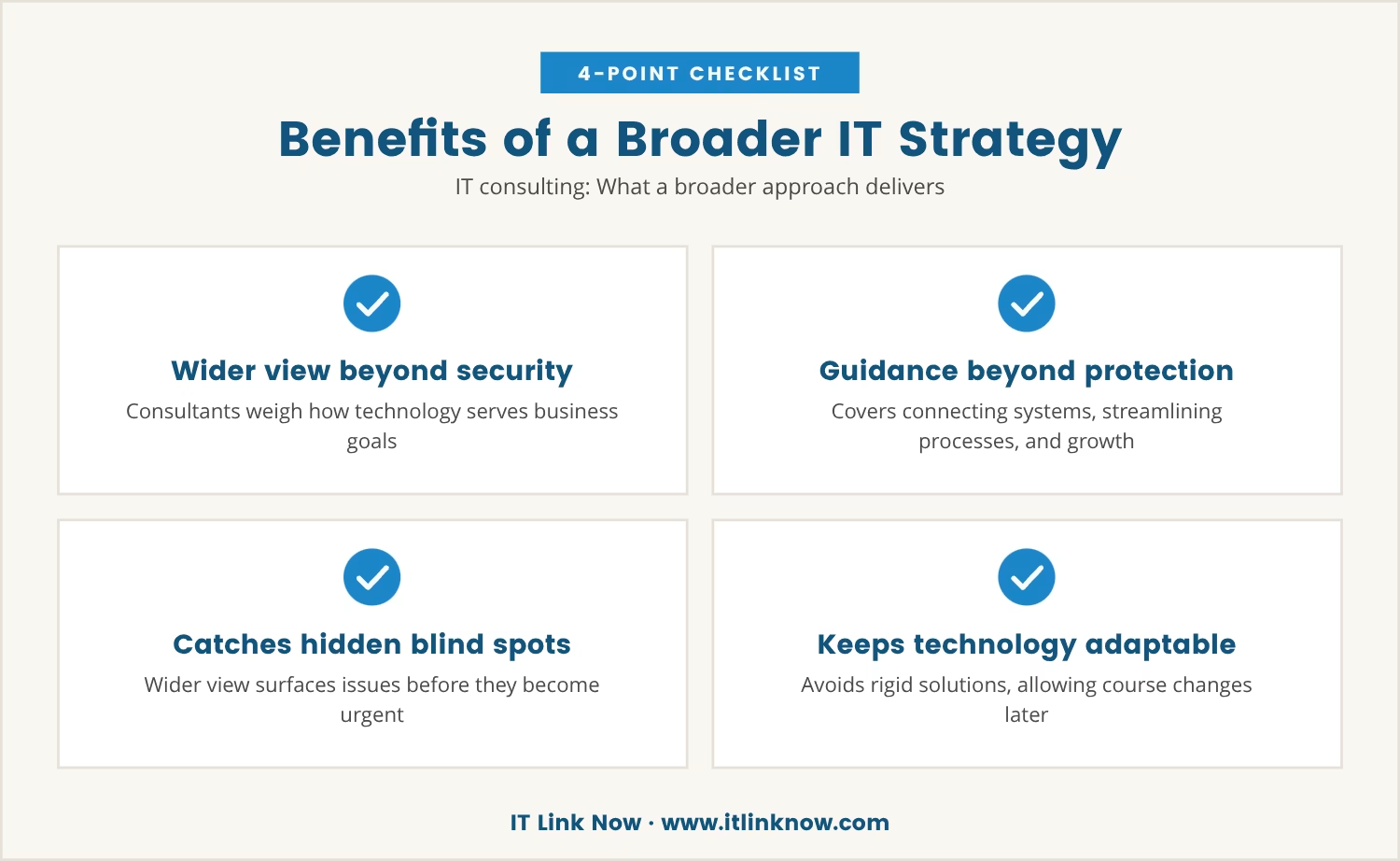
A strong IT consulting strategy looks past the checklist entirely, weighing how technology serves business goals rather than measuring only how well it protects data.
Work with a consultant who takes in the whole picture, and the payoff extends well beyond security: guidance on connecting systems, streamlining processes, and preparing for growth. That wider view is what catches the blind spots that would otherwise surface later, usually at the worst possible time.
It also keeps the technology itself flexible. Rather than locking a business into rigid solutions, a broader approach leaves room to change course as circumstances do.
Plenty of businesses assume that a complete security checklist means safe systems, but that assumption can build in weaknesses nobody notices until later. Here's how:
A checklist cannot show how well a new tool will mesh with existing systems, and poor integration tends to surface as inefficiency and error.
Security controls that are clumsy to use tend to frustrate a team, and once people start finding workarounds, those protections stop doing their job.
A checklist rarely asks whether the technology actually supports real objectives, which can leave a business with systems that are secure but useless for growth.
Checklists are built around today's risks, so they often leave a business unprepared for shifts in its industry or its own direction.
Lean on a checklist alone, and it's easy to believe systems are fully protected even while real gaps sit untouched in the broader strategy.
Some vendors lean on checklists to steer businesses toward their own products, which makes switching later, if needs change, much harder than it should be.
A checklist-first approach tends to leave fingerprints across daily operations. Watch for these warning signs:
Recognize more than one of these, and the technology strategy behind them likely needs a broader review.
Choosing the right IT consulting partner means looking past the checklist from the start, beginning with how well its approach supports the business as a whole.
Favor firms willing to spend time understanding real goals rather than just security requirements. They should be asking about workflows, growth plans, and how teams actually use technology day to day.
Ask yourself: does the current IT consulting company help connect the systems in place, or does it only secure them? The honest answer says a lot about whether the strategy underneath is genuinely strong or simply looks that way on paper.
A resilient technology foundation starts from treating security as one piece of a larger strategy rather than the whole of it. Choose an IT consulting firm that balances protection against usability and growth, and the business underneath is positioned for the long run.
That balance is what keeps the hidden risks of checklist-only thinking from ever taking hold, and it means the systems built today can keep adapting as needs shift, without ever leaving the business exposed along the way.

If your business has 15 to 70 users, you may be realizing that a checklist approach to IT consulting leaves important gaps in your technology strategy. At IT Link Now, we understand how easy it is to overlook the bigger picture when security is the only focus.
We invite you to see how our team approaches technology decisions differently—balancing protection with usability and growth. Let’s talk about what your setup really needs.
Get free onboarding from IT Link Now, with no price increases or surprise bills—so you can upgrade your IT support without hidden costs.
[.mspl-button-text]Start free onboarding[.mspl-button-text]
If a vendor rarely asks about business goals or how the team actually works, and the conversation stays fixed on security controls, the bigger picture is probably getting missed. A strong consulting firm connects technology to operations rather than simply locking it down.
Look for consulting services that dig into workflows, future plans, and how systems interact with each other. The firm should offer real guidance on integration, cloud services, and how technology can actively support business growth.
Yes. A vendor that only checks off security requirements can leave cloud services working poorly alongside other tools, and that friction often breeds inefficiency or opens the very security gaps people start working around.
Integration keeps systems working together, cutting down on errors and wasted time. A consulting company that understands integration well helps a business sidestep costly problems and keeps the technology simpler to live with.
Watch for frequent workarounds, disconnected systems, or unclear ownership of key tools. Spotting these patterns is usually a sign the strategy behind them needs a broader review from an outside, expert perspective.
We help South Florida businesses with 15+ employees get reliable IT support.
Let's onboard you for free, lock in your rate, and handle the switch.